
Tata Capital Ltd, set to launch its IPO next week, has identified green financing and digital innovation as its core growth pillars, backed by the merger of its IFC-backed subsidiary Tata Cleantech Capital in 2024. By FY25, the cleantech and infrastructure finance book reached Rs 18,000 crore, growing at a 31.8 per cent CAGR over the last two years, the NBFC said on Friday.

India's equity markets may have expanded rapidly, but initial public offerings (IPOs) are increasingly becoming exit vehicles for early investors rather than as engines for raising long-term capital, a shift that undermines the spirit of public markets, Chief Economic Advisor V Anantha Nageswaran warned on Monday at a CII event.

The World Bank on Wednesday lowered India's growth forecast for the current fiscal by 4 percentage points to 6.3 per cent amid global economic weakness and policy uncertainty. In its previous estimate, the World Bank had projected India's growth at 6.7 per cent for the fiscal year 2025-26.

The Adani group, which operates across multiple infrastructure sectors, with 12 listed entities in India and a combined market capitalisation of about $200 billion, remains "anchored by strong assets and robust cash flows", according to a Bank of America (BofA) report.

Ahead of the Union Budget for 2023-24, Budget makers have welcomed the global consensus view that India will remain one of the bright spots in calendar year 2023. But there is some alarm over the grim global situation and how that might impact the Centre's projections and assessments for next financial year. The big global headwinds include a deep and sustained recession in the West, including India's biggest trading partners in North America and Europe, continuing volatility in commodity markets, and renewed Covid-19 fears, as lifting of strict curbs by China could potentially lead to a massive spread again.

Despite a strong 7.8 per cent growth in the first quarter, the Indian economy is expected to grow at 6.5 per cent in the current financial year as the impact of US tariffs on Indian exports will reduce prospects, particularly in the second half, ADB said on Tuesday.

Large tariffs by the United States administration and elevated geopolitical risk have increased near-term global financial stability risks, and along with weather events pose downside risks to domestic growth, Reserve Bank of India (RBI) Governor Sanjay Malhotra said in the foreword to the Financial Stability Report released on Monday.
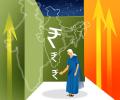
S&P Global Ratings on Tuesday upped India's GDP growth forecast for the current fiscal to 6.5 per cent, citing lower crude prices, monetary easing and normal monsoon, and said the ongoing geopolitical tensions are unlikely to put a "significant pressure" on the rupee or inflation.
Deloitte on Thursday projected economic growth at 6.5-6.7 per cent for the current fiscal, as tax incentives provided in the Budget are expected to push domestic demand amid an uncertain global trade environment. Deloitte estimated India's GDP growth at 6.3-6.5 per cent for FY25 and said that the economic outlook for FY26 hinges on a delicate balance between evolving trade relations and government efforts to boost domestic consumer demand.

Fitch Ratings on Thursday cut India's GDP growth estimate by 10 basis points to 6.4 per cent for the current fiscal, but retained the projections for the next financial year, on concerns over a 'severe' escalation in global trade war. "It is hard to predict US trade policy with any confidence. Massive policy uncertainty is hurting business investment prospects, equity price falls are reducing household wealth, and US exporters will be hit by retaliation," Fitch said in its special update to quarterly Global Economic Outlook (GEO).
NITI Aayog member Arvind Virmani on Monday said India is set to become the fourth largest economy in the world by the end of 2025, an assertion which came days after NITI CEO BVR Subrahmanyam claimed India has already overtaken Japan to reach that spot. The International Monetary Fund (IMF), in its World Economic Outlook (WEO) report released in April had said that India is expected to be the fourth largest economy in the world with a GDP of $4.19 trillion in 2025, ahead of Japan.

India is well-positioned to deal with the negative effects of US tariffs and global trade disruptions as domestic growth drivers and low dependence on exports anchor the economy, Moody's Ratings said on Wednesday.

Strategic affairs experts express concern over US President Donald Trump's tariffs on India, his 'bullying tactics,' and increasing attempts to hyphenate New Delhi with Islamabad, signaling a potential shift in the bilateral relationship.

'GST reduction will help larger and high-end cars too.'
India's economic growth forecast for 2025 has been revised downward to 6.3 per cent, and despite a projected moderation, the country remains one of the fastest-growing large economies, supported by resilient consumption and government spending, the United Nations has said.

Moody's Ratings on Tuesday cut India's GDP growth projections for 2025 to 6.3 per cent, from 6.5 per cent, saying economies globally will see a slowdown on account of heightened US policy uncertainty and trade restrictions.

The RBI on Wednesday cautioned that while the Indian economy appears capable of weathering the deterioration in geopolitical conditions amid the ongoing Russia-Ukraine war, it faces headwinds from global spillovers from geopolitical tensions, elevated commodity prices and moderating external demand. The RBI, however, did not tinker with the GDP growth projection made in April. It had slashed the GDP growth projection for the fiscal 2022-23 to 7.2 per cent from its earlier forecast of 7.8 per cent.

Days after Moody's cut its gross domestic product (GDP) forecast for financial year 2022-23 (FY23) after the official GDP print for the June quarter came in lower than expectations, the global ratings agency said it would maintain its long-term sovereign debt credit rating and outlook on Asia's third-largest economy. "The credit profile of India reflects key strengths, including its large and diversified economy with high growth potential, a relatively strong external position, and a stable domestic financing base for government debt," Moody's said on Tuesday. "We do not expect rising challenges to the global economy, including the impact of the Russia-Ukraine military conflict, higher inflation, and the tightening financial conditions on the back of policy tightening, to derail India's ongoing recovery from the pandemic in 2022 and 2023," it said.

India's extreme poverty rate declined sharply to 5.3 per cent over a decade from 27.1 per cent in 2011-12 even as the World Bank revised upwards its threshold poverty line to $3 per day.

The Indian pharmaceutical industry is likely to benefit from a major wave of patent expiries in the US, as small-molecule drugs worth $63.7 billion are expected to go off-patent between 2025-29, a 65 per cent rise over the previous five years, according to a report by Antique stock broking limited.

The International Monetary Fund (IMF) has said India and China will account for half of the global economic growth in 2023, as the multilateral agency retained its growth forecast for Asia's third-largest economy for 2023-24 (FY24). "India remains a bright spot. Together with China, it will account for half of global growth this year, versus just a tenth for the US and euro area combined," the IMF said in its latest update to the biannual World Economic Outlook. Growth in India is set to decline from 6.8 per cent in 2022 (FY23) to 6.1 per cent in 2023 (FY24) before picking up to 6.8 per cent in 2024 (FY25), the global lender said while citing "resilient domestic demand despite external headwinds".
The Asian Development Bank (ADB) on Wednesday lowered India's growth forecast for FY26 to 6.5 per cent from 6.7 per cent on account of trade uncertainty and higher US tariffs that are expected to impact exports and investment. Despite the downward revision from the April 2025 Asian Development Outlook (ADO), India remains one of the fastest-growing major economies in the world.

The Reserve Bank of India on Friday revised upwards the GDP growth projection for the current fiscal to 7.2 per cent from 7 per cent on rising private consumption and revival of demand in rural areas. Unveiling the bi-monthly monetary policy, RBI Governor Shaktikanta Das said estimates released by the National Statistical Office (NSO) placed India's real gross domestic product (GDP) growth at 8.2 per cent in 2023-24. "During 2024-25 so far, domestic economic activity has maintained resilience," he said, adding that manufacturing activity continues to gain ground on the back of strengthening domestic demand.

Led by a sharper-than-expected deceleration in industrial activity, economic growth in India slowed more than anticipated and is projected to remain at 6.5 per cent till 2026, the International Monetary Fund said on Friday. "Growth in India slowed more than expected, led by a sharper-than-expected deceleration in industrial activity," the IMF said in its latest update of the World Economic Outlook, according to which the global economy is holding steady. In 2023, India's growth rate was 8.2 per cent, which dropped to 6.5 per cent in 2024.

S&P Global Ratings on Thursday said the hostilities between India and Pakistan heighten risks to the credit metrics of both countries, and any escalation in clashes would put downward pressure on sovereign credit support.

India will be the world's third-largest economy by 2028 as it becomes the world's most sought-after consumer market and gains share in global output, driven by macro stability influenced policy and better infrastructure, Morgan Stanley said. From a $3.5 trillion economy in 2023, the Indian economy is projected to expand to $4.7 trillion in 2026, which will make it the fourth largest in the world behind the US, China and Germany.
Geopolitical tensions, trade policy uncertainties, volatility in international commodity prices and financial market uncertainties pose considerable risks to India's economic growth in the coming year, the finance ministry cautioned on Wednesday. "Global trade continues to be affected by uncertainty in the policy environment... tariff-related developments in multiple countries have heightened trade-related risks, affecting investment and trade flows globally.

Genset manufacturer Cummins India has seen its share price rise by 45 per cent in the past three months. The management has reaffirmed that growth would be in double digits over the coming two fiscal years. Growth is expected to be driven by a pickup in domestic infrastructure spending.
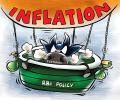
The Reserve Bank of India on Friday retained its projection for retail inflation at 4.5 per cent for the current fiscal assuming a normal monsoon, while emphasising that uncertainties related to food price outlook warrant a close monitoring. Consumer Price Index (CPI)-based retail inflation has been projected at 4.5 per cent with quarter-wise projections at 4.9 per cent in Q1 (April-June), 3.8 per cent in Q2, 4.6 per cent in Q3, and 4.5 per cent in Q4.

India has been relatively insulated from the severe headwinds in the West. However, with a third of the global economy expected to slip into recession in calendar year 2023, the impact will strongly be felt on India's exports and trade economy, leading economists said in a panel discussion at the Business Standard BFSI Insight Summit in Mumbai on Wednesday. The panel comprised former Reserve Bank of India executive director and former Monetary Policy Committee member Mridul Saggar, State Bank of India Chief Economic Advisor Soumya Kanti Ghosh, Citibank India Chief Economist Samiran Chakraborty, ICRA Chief Economist Aditi Nayar, and IndusInd Bank Chief Economist Gaurav Kapoor. The topic of the panel discussion was No recession in sight: Is India decoupled from developed economies?

From social editor to Vogue's new leader, Chloe Malle embraces her 'nepo baby' status, ready to shape the future of fashion media.

India's Foreign Secretary Vikram Misri has underscored the importance of not equating the victims and perpetrators of terror attacks, highlighting the need for global unity in combating terrorism. Speaking at Raisina Tokyo 2025, Misri expressed appreciation for Japan's support following the recent terror attack in Pahalgam, India. He also cautioned against the trend of some Western countries hyphenating India and Pakistan in the context of their recent military confrontation. Misri further outlined India's economic aspirations and its commitment to becoming a factor of stability in a turbulent world.

India's economy is projected to grow between 6.3 per cent and 6.8 per cent in FY26, according to the Economic Survey 2024-25, tabled in Parliament on Friday. The survey highlights that the country's economic fundamentals remain strong, supported by a stable external account, fiscal consolidation, and private consumption. It noted that the government plans to strengthen long-term industrial growth by focusing on research and development (R&D), micro, small, and medium enterprises (MSMEs), and capital goods.

Reflecting subdued global economic growth, India's outward foreign direct investment (FDI) fell by 33.3 per cent sequentially to $1.21 billion in August, compared to over $1.82 billion in July.

Announcing the bi-monthly monetary policy, Reserve Bank of India Governor Shaktikanta Das said the RBI's internal survey says manufacturing, services and infrastructure sector firms are optimistic of the business outlook.

'People are taking effort to train and adapt to current skills.' 'If that is not there, they are not useful to us.' 'They have to adapt to new technology, and what is important is learnability.'

New-age stocks to buy: Most new-age stocks have turned out to be wealth destroyers in stock markets, so far, in calendar year 2025. Shares of Ola Electric Mobility, for instance, have plunged nearly 50 per cent in the first half of CY 2025, while those of Swiggy, PB Fintech, Paytm, and Eternal (Zomato) have crashed between 6 per cent and 25 per cent, ACE Equity data shows.

Sources close to the top BJP leadership tell me that Tharoor has already had secret meetings with the BJP's top brass and is waiting patiently to make his next move, reports Ramesh Menon.
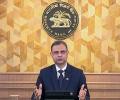
Since February 2025, the RBI has reduced the policy rate by 100 basis points. In its previous policy review in April, it had also trimmed the repo rate by 25 basis points to 6 per cent.

'If you look at the order books of capital equipment companies or money deployed on the ground, there is forward movement in terms of actual investment by the private sector.'
